 The Upper Room Daily Reflections: daily words of wisdom and faith of The United Methodist Church in Nashville, Tennessee, United States for Monday, 9 October 2017 "God of the Heavens"
Today’s Reflection:
 MAY THE GOD of the heavens
and of the earth
enter into the place within you
that holds the keenest chaos,
the deepest mystery,
the most intense darkness
and there
may the God of
sun and moon
stars and seasons
breathe the words
that will bring forth
a new world. Amen. (In the Sanctuary of Women)
From page 254 of In the Sanctuary of Women: A Companion for Reflection & Prayer by Jan L. Richardson. Copyright © 2010 by Jan L. Richardson. All rights reserved. Used by permission of Upper Room Books. http://bookstore.upperroom.org/ Learn more about or purchase this book.
Today’s Question: Pray today’s prayer. MAY THE GOD of the heavens
and of the earth
enter into the place within you
that holds the keenest chaos,
the deepest mystery,
the most intense darkness
and there
may the God of
sun and moon
stars and seasons
breathe the words
that will bring forth
a new world. Amen.
Today’s Scripture:
But remember the LORD your God, for it is he who gives you power to get wealth, so that he may confirm his covenant that he swore to your ancestors, as he is doing today. (Deuteronomy 8:18, NRSV)
This Week: pray for your friends.
-------
Did You Know?
In need of prayer? The Upper Room Living Prayer Center is a 7-day-a-week intercessory prayer ministry staffed by trained volunteers. Call 1-800-251-2468 or visit The Living Prayer Center website.
-------
This week we remember: Wilfrid, October 12).
October 12.—ST. WILFRID, Bishop.
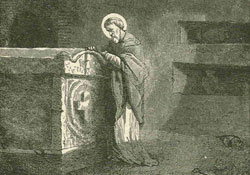 "A QUICK walker, expert at all good works, with never a sour face"—such was the great St. Wilfrid, whose glory it was to secure the happy links which bound England to Rome. He was born about the year 634, and was trained by the Celtic monks at Lindisfarne in the peculiar rites and usages of the British Church. Yet even as a boy Wilfrid longed for perfect conformity in discipline, as in doctrine, with the Holy See, and at the first chance set off himself for Rome. On his return he founded at Ripon a strictly Roman monastery, under the rule of St. Benedict. In the year 664 he was elected Bishop of Lindisfarne, and five years later was transferred to the see of York. He had to combat the passions of wicked kings, the cowardice of worldly prelates, the errors of holy men. He was twice exiled and once imprisoned; yet the battle which he fought was won. He swept away the abuses of many years and a too national system, and substituted instead a vigorous Catholic discipline, modelled and dependent on Rome. He died October 12, 709, and at his death was heard the sweet melody of the angels conducting his soul to Christ.
Reflection.—To look towards Rome is an instinct planted in us for the preservation of the Faith. Trust in the Vicar of Christ necessarily results from the reign of His love in our hearts.
-------
Lectionary Readings for Sunday, 15 October 2017
(Courtesy of Vanderbilt Divinity Library)
Exodus 32:1-14
Psalm 106:1-6, 19-23
Philippians 4:1-9
Matthew 22:1-14
Scripture Texts: Exodus 32:1 When the people saw that Moshe was taking a long time to come down from the mountain, they gathered around Aharon and said to him, “Get busy; and make us gods to go ahead of us; because this Moshe, the man that brought us up from the land of Egypt — we don’t know what has become of him.” 2 Aharon said to them, “Have your wives, sons and daughters strip off their gold earrings; and bring them to me.” 3 The people stripped off their gold earrings and brought them to Aharon. 4 He received what they gave him, melted it down, and made it into the shape of a calf. They said, “Isra’el! Here is your god, who brought you up from the land of Egypt!” 5 On seeing this, Aharon built an altar in front of it and proclaimed, “Tomorrow is to be a feast for Adonai.” 6 Early the next morning they got up and offered burnt offerings and presented peace offerings. Afterwards, the people sat down to eat and drink; then they got up to indulge in revelry.
7 Adonai said to Moshe, “Go down! Hurry! Your people, whom you brought up from the land of Egypt, have become corrupt! 8 So quickly they have turned aside from the way I ordered them to follow! They have cast a metal statue of a calf, worshipped it, sacrificed to it and said, ‘Isra’el! Here is your god, who brought you up from the land of Egypt!’” 9 Adonai continued speaking to Moshe: “I have been watching these people; and you can see how stiffnecked they are. 10 Now leave me alone, so that my anger can blaze against them, and I can put an end to them! I will make a great nation out of you instead.”
11 Moshe pleaded with Adonai his God. He said, “Adonai, why must your anger blaze against your own people, whom you brought out of the land of Egypt with great power and a strong hand? 12 Why let the Egyptians say, ‘It was with evil intentions that he led them out, to slaughter them in the hills and wipe them off the face of the earth’? Turn from your fierce anger! Relent! Don’t bring such disaster on your people! 13 Remember Avraham, Yitz’chak and Isra’el, your servants, to whom you swore by your very self. You promised them, ‘I will make your descendants as many as the stars in the sky; and I will give all this land I have spoken about to your descendants; and they will possess it forever.’” 14 Adonai then changed his mind about the disaster he had planned for his people.
Psalm 106:1 Halleluyah!
Give thanks to Adonai; for he is good,
for his grace continues forever.
2 Who can express Adonai’s mighty doings
or proclaim in full his praise?
3 How happy are those who act justly,
who always do what is right!
4 Remember me, Adonai, when you show favor to your people,
keep me in mind when you save them;
5 so I can see how well things are going
with those whom you have chosen,
so that I can rejoice in your nation’s joy,
and glory in your heritage.
6 Together with our ancestors, we have sinned,
done wrong, acted wickedly., 19 In Horev they fashioned a calf,
they worshipped a cast metal image.
20 Thus they exchanged their Glory
for the image of an ox that eats grass!
21 They forgot God, who had saved them,
who had done great things in Egypt,
22 wonders in the land of Ham,
fearsome deeds by the Sea of Suf.
23 Therefore he said that he would destroy them,
[and he would have,] had not Moshe his chosen one
stood before him in the breach
to turn back his destroying fury.
Philippians 4:1 So, my brothers, whom I love and long for, my joy and my crown, my dear friends, keep standing firm in union with the Lord.
2 I beg Evodia and I beg Syntyche to agree with each other in union with the Lord. 3 I also request you, loyal Syzygus, to help these women; for they have worked hard proclaiming the Good News with me, along with Clement and the rest of my fellow-workers whose names are in the Book of Life.
4 Rejoice in union with the Lord always! I will say it again: rejoice! 5 Let everyone see how reasonable and gentle you are. The Lord is near! 6 Don’t worry about anything; on the contrary, make your requests known to God by prayer and petition, with thanksgiving. 7 Then God’s shalom, passing all understanding, will keep your hearts and minds safe in union with the Messiah Yeshua. 8 In conclusion, brothers, focus your thoughts on what is true, noble, righteous, pure, lovable or admirable, on some virtue or on something praiseworthy. 9 Keep doing what you have learned and received from me, what you have heard and seen me doing; then the God who gives shalom will be with you.
Matthew 22:1Yeshua again used parables in speaking to them: 2 “The Kingdom of Heaven is like a king who prepared a wedding feast for his son, 3 but when he sent his slaves to summon the invited guests to the wedding, they refused to come. 4 So he sent some more slaves, instructing them to tell the guests, ‘Look, I’ve prepared my banquet, I’ve slaughtered my bulls and my fattened cattle, and everything is ready. Come to the wedding!’ 5 But they weren’t interested and went off, one to his farm, another to his business; 6 and the rest grabbed his slaves, mistreated them and killed them. 7 The king was furious and sent his soldiers, who killed those murderers and burned down their city.
8 “Then he said to his slaves, ‘Well, the wedding feast is ready; but the ones who were invited didn’t deserve it. 9 So go out to the street-corners and invite to the banquet as many as you find.’ 10 The slaves went out into the streets, gathered all the people they could find, the bad along with the good; and the wedding hall was filled with guests.
11 “Now when the king came in to look at the guests, he saw there a man who wasn’t dressed for a wedding; so he asked him, 12 ‘Friend, how did you get in here without wedding clothes?’ The man was speechless. 13 Then the king said to the servants, ‘Bind him hand and foot, and throw him outside in the dark!’ In that place people will wail and grind their teeth, 14 for many are invited, but few are chosen.”
-------
John Wesley's Notes-Commentary: Exodus 32:1-14
Verse 1
[1] And when the people saw that Moses delayed to come down out of the mount, the people gathered themselves together unto Aaron, and said unto him, Up, make us gods, which shall go before us; for as for this Moses, the man that brought us up out of the land of Egypt, we wot not what is become of him.
Up, make us gods which shall go before us. They were weary of waiting for the promised land. They thought themselves detained too long at mount Sinai. They had a God that stayed with them, but they must have a God to go before them to the land flowing with milk and honey. They were weary of waiting for the return of Moses: As for this Moses, the man that brought us up out of Egypt, we know not what is become of him - Observe how slightly they speak of his person, this Moses: And how suspiciously of his delay, we know not what is become of him. And they were weary of waiting for a divine institution of religious worship among them, so they would have a worship of their own invention, probably such as they had seen among the Egyptians. They say, make us gods which shall go before us. Gods! How many would they have? Is not one sufficient? And what good would gods of their own making do them? They must have such Gods to go before them as could not go themselves farther than they were carried!
Verse 2
[2] And Aaron said unto them, Break off the golden earrings, which are in the ears of your wives, of your sons, and of your daughters, and bring them unto me.
And Aaron said break off the golden ear-rings — We do not find that he said one word to discountenance their proposal. Some suppose, that when Aaron bid them break off their ear-rings, he did it with design to crush the proposal, believing that, though their covetousness would have let them do it, yet their pride would not have suffered them to part with them.
Verse 3
[3] And all the people brake off the golden earrings which were in their ears, and brought them unto Aaron.
And all the people brake off their ear-rings — Which Aaron melted down, and, having a mold prepared, poured the melted gold into it, and then produced it in the shape of an ox or calf, giving it some finishing strokes with a graving tool.
Verse 5
[5] And when Aaron saw it, he built an altar before it; and Aaron made proclamation, and said, To morrow is a feast to the LORD.
And Aaron built an altar before it, and proclaimed a feast — A feast of dedication; yet he calls it a feast to Jehovah; for, as brutish as they were, they did not design to terminate their adoration in the image; but they made it for a representation of the true God, whom they intended to worship in and through this image. And yet this did not excuse them from gross idolatry, no more than it will excuse the Papists, whose plea it is, that they do not worship the image, but God by the image; so making themselves just such idolaters as the worshippers of the golden calf, whose feast was a feast to Jehovah, and proclaimed to be so, that the most ignorant and unthinking might not mistake it.
Verse 6
[6] And they rose up early on the morrow, and offered burnt offerings, and brought peace offerings; and the people sat down to eat and to drink, and rose up to play.
And they rose up early on the morrow, and offered sacrifice to this new made deity. And the people sat down to eat and drink of the remainder of what was sacrificed, and then rose up to play - To play the fool, to play the wanton. It was strange that any of the people, especially so great a number of them, should do such a thing. Had they not, but the other day, in this very place, heard the voice of the Lord God speaking to them out of the midst of the fire, Thou shalt not make to thyself any graven image? - Yet They made a calf in Horeb, the very place where the law was given It was especially strange that Aaron should be so deeply concerned, should make the calf and proclaim the feast! Is this Aaron the saint of the Lord! Is this he that had not only seen, but had been employed in summoning the plagues of Egypt, and the judgments executed upon the gods of the Egyptians? What! And yet himself copying out the abandoned idolatries of Egypt? How true is it, that the law made them priests which had infirmity, and needed first to offer for their own sins?
Verse 8
[8] They have turned aside quickly out of the way which I commanded them: they have made them a molten calf, and have worshipped it, and have sacrificed thereunto, and said, These be thy gods, O Israel, which have brought thee up out of the land of Egypt.
They have turned aside quickly — Quickly after the law was given them, and they had promised to obey it; quickly after God had done such great things for them, and declared his kind intentions to do greater.
Verse 9
[9] And the LORD said unto Moses, I have seen this people, and, behold, it is a stiffnecked people:
It is a stiff-necked people — Unapt to come under the yoke of the divine law, averse to all good, and prone to evil, obstinate to the methods of cure.
Verse 10
[10] Now therefore let me alone, that my wrath may wax hot against them, and that I may consume them: and I will make of thee a great nation.
Let me alone — What did Moses, or what could he do, to hinder God from consuming them? When God resolves to abandon a people, and the decree is gone forth, no intercession can prevent it. But God would thus express the greatness of his displeasure, after the manner of men, who would have none to interceed for those they resolve to be severe with. Thus also he would put an honour upon prayer, intimating, that nothing but the intercession of Moses could save them from ruin, that he might be a type of Christ, by whose mediation alone God would reconcile the world unto himself.
Verse 11
[11] And Moses besought the LORD #1# his God, and said, LORD, why doth thy wrath wax hot against thy people, which thou hast brought forth out of the land of Egypt with great power, and with a mighty hand?
And Moses besought the Lord his God — If God would not be called the God of Israel, yet he hoped he might address him as his own God. Now Moses is standing in the gap to turn away the wrath of God. Psalms 106:23. He took the hint which God gave him when he said, Let me alone, which, though it seemed to forbid his interceding, did really encourage it, by shewing what power the prayer of faith hath with God.
Verse 12
[12] Wherefore should the Egyptians speak, and say, For mischief did he bring them out, to slay them in the mountains, and to consume them from the face of the earth? Turn from thy fierce wrath, and repent of this evil against thy people.
Turn from thy fierce wrath — Not as if he thought God were not justly angry, but he begs that he would not be so greatly angry as to consume them. Let mercy rejoice against judgment; repent of this evil - Change the sentence of destruction into that of correction, against thy people which thou broughtest up out of Egypt - For whom thou hast done so great things? Wherefore should the Egyptians say, For mischief did he bring them out - Israel is dear to Moses, as his kindred, as his charge; but it is the glory of God that he is most concerned for. If Israel could perish without any reproach to God's name, Moses could persuade himself to sit down contented; but he cannot bear to hear God reflected on; and therefore this he insists upon, Lord, What will the Egyptians say? They will say, God was either weak, and could not, or fickle, and would not compleat the salvation he begun.
Verse 13
[13] Remember Abraham, Isaac, and Israel, thy servants, to whom thou swarest by thine own self, and saidst unto them, I will multiply your seed as the stars of heaven, and all this land that I have spoken of will I give unto your seed, and they shall inherit it for ever.
Remember Abraham — Lord, if Israel be cut off, what will become of the promise?
Verse 14
[14] And the LORD repented of the evil which he thought to do unto his people.
And the Lord repented of the evil he thought to do — Though he designed to punish them, yet he would not ruin them. See here, the power of prayer, God suffers himself to be prevailed with by humble believing importunity. And see the compassion of God towards poor sinners, and how ready he is to forgive.
Psalm 106:1-6, 19-23
Verse 4
[4] Remember me, O LORD, with the favour that thou bearest unto thy people: O visit me with thy salvation;
Me — He speaks here in the name, and on the behalf of the whole nation. With-With those favours which thou dost usually and peculiarly give to thy people.
Verse 5
[5] That I may see the good of thy chosen, that I may rejoice in the gladness of thy nation, that I may glory with thine inheritance.
See — Enjoy.
Chosen — Of thy chosen people; such as are Israelites indeed.
Gladness — Such joy as thou hast formerly afforded unto thy beloved nation.
Glory — That we may have occasion to glory in God's goodness towards us.
Inheritance — In the congregation of thy people.
Verse 6
[6] We have sinned with our fathers, we have committed iniquity, we have done wickedly.
Glory — As our fathers did.
Verse 19
[19] They made a calf in Horeb, and worshipped the molten image.
A calf — When they were but just brought out of Egypt by such wonders, and had seen the plagues of God upon the Egyptian idolaters, and when the law of God was but newly delivered to them in such a tremendous manner.
Verse 20
[20] Thus they changed their glory into the similitude of an ox that eateth grass.
Their glory — God, who was indeed their glory.
Into — Into the golden image of an ox or calf, which is so far from feeding his people, as the true God did the Israelites, that he must be fed by them.
Verse 23
[23] Therefore he said that he would destroy them, had not Moses his chosen stood before him in the breach, to turn away his wrath, lest he should destroy them.
Breach — God had made a wall about them; but they had made a breach in it by their sins, at which the Lord, who was now justly become their enemy, might enter to destroy them; which he had certainly done, if Moses by his prevailing intercession had not hindered him.
Philippians 4:1-9
Verse 1
[1] Therefore, my brethren dearly beloved and longed for, my joy and crown, so stand fast in the Lord, my dearly beloved.
So stand — As ye have done hitherto.
Verse 2
[2] I beseech Euodias, and beseech Syntyche, that they be of the same mind in the Lord.
I beseech — He repeats this twice, as if speaking to each face to face, and that with the utmost tenderness.
Verse 3
[3] And I intreat thee also, true yokefellow, help those women which laboured with me in the gospel, with Clement also, and with other my fellowlabourers, whose names are in the book of life.
And I entreat thee also, true yokefellow — St. Paul had many fellowlabourers, but not many yokefellows. In this number was Barnabas first, and then Silas, whom he probably addresses here; for Silas had been his yokefellow at the very place, Acts 16:19.
Help those women who laboured together with me — Literally, who wrestled. The Greek word doth not imply preaching, or anything of that kind; but danger and toil endured for the sake of the gospel, which was also endured at the same time, probably at Philippi, by Clement and my other fellowlabourers - This is a different word from the former, and does properly imply fellowpreachers. Whose names, although not set down here, are in the book of life - As are those of all believers. An allusion to the wrestlers in the Olympic games, whose names were all enrolled in a book. Reader, is thy name there? Then walk circumspectly, lest the Lord blot thee out of his book!
Verse 5
[5] Let your moderation be known unto all men. The Lord is at hand.
Let your gentleness — Yieldingness, sweetness of temper, the result of joy in the Lord.
Be known — By your whole behaviour.
To all men — Good and bad, gentle and froward. Those of the roughest tempers are good natured to some, from natural sympathy and various motives; a Christian, to all.
The Lord — The judge, the rewarder, the avenger.
Is at hand — Standeth at the door.
Verse 6
[6] Be careful for nothing; but in every thing by prayer and supplication with thanksgiving let your requests be made known unto God.
Be anxiously careful for nothing - If men are not gentle towards you, yet neither on this, nor any other account, be careful, but pray. Carefulness and prayer cannot stand together.
In every thing — Great and small.
Let your requests be made known — They who by a preposterous shame or distrustful modesty, cover, stifle, or keep in their desires, as if they were either too small or too great, must be racked with care; from which they are entirely delivered, who pour them out with a free and filial confidence.
To God — It is not always proper to disclose them to men.
By supplication — Which is the enlarging upon and pressing our petition.
With thanksgiving — The surest mark of a soul free from care, and of prayer joined with true resignation. This is always followed by peace. Peace and thanksgiving are both coupled together, Colossians 3:15.
Verse 7
[7] And the peace of God, which passeth all understanding, shall keep your hearts and minds through Christ Jesus.
And the peace of God — That calm, heavenly repose, that tranquility of spirit, which God only can give.
Which surpasseth all understanding — Which none can comprehend, save he that receiveth it.
Shall keep — Shall guard, as a garrison does a city.
Your hearts — Your affections.
Your minds — Your understandings, and all the various workings of them; through the Spirit and power of Christ Jesus, in the knowledge and love of God. Without a guard set on these likewise, the purity and vigour of our affections cannot long be preserved.
Verse 8
[8] Finally, brethren, whatsoever things are true, whatsoever things are honest, whatsoever things are just, whatsoever things are pure, whatsoever things are lovely, whatsoever things are of good report; if there be any virtue, and if there be any praise, think on these things.
Finally — To sum up all.
Whatsoever things are true — Here are eight particulars placed in two fourfold rows; the former containing their duty; the latter, the commendation of it. The first word in the former row answers the first in the latter; the second word, the second and so on.
True — In speech.
Honest — In action.
Just — With regard to others.
Pure — With regard to yourselves.
Lovely — And what more lovely than truth? Of good report - As is honesty, even where it is not practised.
If there be any virtue — And all virtues are contained in justice.
If there be any praise — In those things which relate rather to ourselves than to our neighbour.
Think on these things — That ye may both practise them yourselves, and recommend them to others.
Verse 9
[9] Those things, which ye have both learned, and received, and heard, and seen in me, do: and the God of peace shall be with you.
The things which ye have learned — As catechumens.
And received — By continual instructions.
And heard and seen — In my life and conversation.
These do, and the God of peace shall be with you — Not only the peace of God, but God himself, the fountain of peace.
Matthew 22:1-14
Verse 2
[2] The kingdom of heaven is like unto a certain king, which made a marriage for his son,
A king, who made a marriage feast for his son — So did God, when he brought his first - begotten into the world.
Verse 3
[3] And sent forth his servants to call them that were bidden to the wedding: and they would not come.
Them that were invited — Namely, the Jews.
Verse 4
[4] Again, he sent forth other servants, saying, Tell them which are bidden, Behold, I have prepared my dinner: my oxen and my fatlings are killed, and all things are ready: come unto the marriage.
Fatlings — Fatted beasts and fowls.
Verse 5
[5] But they made light of it, and went their ways, one to his farm, another to his merchandise:
One to his farm, another to his merchandise — One must mind what he has; another, gain what he wants. How many perish by misusing lawful things!
Verse 7
[7] But when the king heard thereof, he was wroth: and he sent forth his armies, and destroyed those murderers, and burned up their city.
The king sending forth his troops — The Roman armies employed of God for that purpose.
Destroyed those murderers — Primarily the Jews.
Verse 8
[8] Then saith he to his servants, The wedding is ready, but they which were bidden were not worthy.
Go into the highways — The word properly signifies, the by-ways, or turnings of the road.
Verse 10
[10] So those servants went out into the highways, and gathered together all as many as they found, both bad and good: and the wedding was furnished with guests.
They gathered all — By preaching every where.
Verse 11
[11] And when the king came in to see the guests, he saw there a man which had not on a wedding garment:
The guest — The members of the visible Church.
Verse 12
[12] And he saith unto him, Friend, how camest thou in hither not having a wedding garment? And he was speechless.
A wedding garment — The righteousness of Christ, first imputed, then implanted. It may easily be observed, this has no relation to the Lord's Supper, but to God's proceeding at the last day.
Verse 14
[14] For many are called, but few are chosen.
Many are called; few chosen — Many hear; few believe. Yea, many are members of the visible, but few of the invisible Church. Matthew 20:16.
-------
The Upper Room Ministries ®. Copyright © 2017
PO Box 340004
Nashville, Tennessee 37203-0004, United States
-------
PO Box 340004
Nashville, Tennessee 37203-0004, United States
-------

No comments:
Post a Comment