
"Lord, to whom shall we go? You have the words of eternal life."[John 6:68]
Wednesday of the Fourteenth week in Ordinary Time
Saints of the day:
Saints of the day:
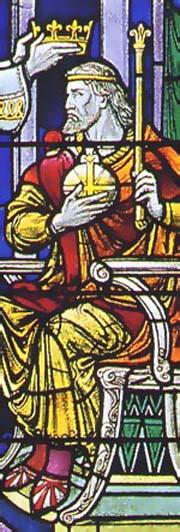
SAINT EDGAR THE PEACEFUL
KING OF ENGLAND
(c.943 - 975)
KING OF ENGLAND
(c.943 - 975)
Although few people have heard of him, King Edgar is regarded as the first ruler of a consolidated England.
Father of Saint Edward the Martyr and great-grandson of Alfred the Great, Edgar was born to king Edmund the Magnificent and St Elfgiva.
He was efficient, peaceful, and unusually tolerant of local customs . He supported his friend Saint Dunstan , who served as his counselor.
England underwent a religious revival in his reign, and he is venerated at Glastonbury.

PETER VIGNE
Priest
(1670-1740)
Priest
(1670-1740)
Peter Vigne was born August 20 1670 in Privas (France), a small town still feeling the effects of the Wars of Religion from the previous century. His father, Peter Vigne, a honest textile merchant, and his mother, Frances Gautier, married in the Catholic Church , had their five children baptised in the Catholic parish of Saint Thomas, Privas. Two daughters died in infancy. Peter and his two older siblings, John-Francis and Eleonore, lived with their parents in relative comfort.
When he was 11 years old, Peter was chosen by the Parish Priest to act as a witness, signing the parish register for Baptisms, Marriages or Deaths.
After receiving a good level of education and instruction, towards the end of his teenage years, his life was suddenly transformed by a new awareness of the presence of Jesus Christ in the Eucharist. This experience led him to centre his life on Jesus, who offered himself on the Cross for love of us, and in the Eucharist, never ceases to give himself to all men. In 1690, he entered the Sulpician Seminary in Viviers. Ordained a priest September 18th,1694 in Bourg Saint Andeol by the Bishop of Viviers, he was sent as curate to Saint-Agreve where, for six years he exercised his priestly ministry, in friendship with his Parish Priest and beloved by his parishioners.
Always attentive to discern in life's events what the Lord was asking of him, he felt called elsewhere. With understandable hesitancy in the beginning and then with increasing certitude, he pursued his spiritual itinerary along new paths. His desire to work as a missionary among the poor was central to his decision to join the Vincentians in Lyon, in 1700. There he received a solid formation in poverty and in conducting "popular missions", and with his fellow priests began visiting towns and villages in the work of evangelization. In 1706, he left the Vincentians of "his own free will". Now more than ever he was passionate for the salvation of souls, especially for the poor people living in the countryside. After a period of searching, his vocation took shape with increasing clarity. He became an "itinerant missionary" applying his own pastoral methods, whilst submitting his ministry to the authorization of his hierarchical superiors.
For more than thirty years he tirelessly travelled on foot or on horseback the ways of Vivarais and Dauphiné, and even further ahead. He faced the fatigue of being constantly on the move, as well as severe weather conditions, in order to make Jesus known, loved and served. He preached, visited the sick, catechised the children, administered the sacraments, even going as far as carrying "his" confessional on his back, ready at all times to celebrate and bestow the Mercy of God. He celebrated Mass, exposed the Blessed Sacrament, and taught the faithful the prayer of Adoration. Mary, "Beautiful Tabernacle of God among men" was also given a place of honour in his prayer and his teaching.
In 1712, he came to Boucieu-le-Roi, where the terrain favoured the erection of a Way of the Cross. With the help of parishioners he constructed 39 stations throughout the village and countryside, teaching the faithful to follow Jesus from the Upper Room to Easter and Pentecost. Boucieu became his place of residence. There, he gathered together a few women, charging them to "accompany the pilgrims" on the Way of the Cross and help them to pray and meditate.
It was there that he founded the Congregation of the Sisters of the Blessed Sacrament. On November 30th, 1715, in the church at Boucieu, he gave them the cross and the religious habit. He invited them to assure continuous adoration of Jesus present in the Eucharist and to live together in fellowship. Anxious to give the youth access to instruction, thus helping them grow in their faith and Christian values, Peter Vigne opened schools and also established a "Training School" for teachers.
Such a challenging and busy lifestyle needed some support. For that reason, whenever Peter Vigne was in Lyon on business, he never failed to call on his former seminary tutors, the priests of Saint Sulpice, to meet his confessor and spiritual director. Drawn by the eucharistic spirituality of the Priests of the Blessed Sacrament, founded by Monsignor d'Authier de Sisgaud, he was accepted as an associate member of this society of priests, on January 25th, 1724, in Valence, and benefited by their spiritual and temporal help.
Whilst continuing to accompany his young Congregation, Peter Vigne persisted with his apostolic works, and to make the fruits of his missions more available, he found time to write books : rules to live by, works of spirituality, especially the one entitled "Meditations on the most beautiful book, Jesus Christ suffering and dying on the Cross".
The physical strength of our pilgrim for God, the demands of his apostolic activities, the long hours he spent in adoration and his life of poverty, bear witness not only to a fairly robust physique, but above all to a passionate love of Jesus Christ who loved his own to the end (John 13:1).
At the age of 70, the effects of exhaustion began to show. During a mission at Rencurel, in the Vercors mountains, he was taken ill and had to interrupt his preaching. Despite all his efforts to celebrate the Eucharist one more time and encourage the faithful to love Jesus, feeling his end was near, he expressed once again his missionary zeal, then withdrew in quiet prayer and reflection. A priest and two Sisters came in haste to accompany him in his final moments. On July 8th, 1740, he went to join the One he had so loved, adored and served. His body was taken back to its final resting place in the little church in Boucieu where it remains to this day.
He was beatified by John Paul II on October 3rd, 2004. - Copyright © Libreria Editrice Vaticana
Blessed Gregory Grassi and Companions
July 8 - Blessed Gregory Grassi and Companions
About 25,000 Catholics in China and 43 European missionaries won the martyr's crown during the so-called Boxer Persecution of 1900. The Boxers were a fanatical sect who hated all foreigners and especially the Catholic Church. With the approval of the empress dowager Tzu Chi, then ruling the Chinese Empire, they went about burning churches and murdering missionaries and their neophytes.
One of the principal promoters of the Boxer movement as the governor Yu Hsien who resided at Taiyuanfu, Shansi. In this city was also the residence of the Franciscan Bishop Gregory Grassi, vicar apostolic of northern Shansi, and his coadjutor, Bishop Francis Fogolla. Here were also a seminary and an orphanage. The latter was conducted by Franciscan Missionary Sisters of Mary who had arrived only the previous year.
During the night of July 5, Yu Hsien's soldiers appeared at the Franciscan mission and arrested the two bishops, two fathers and a brother, and seven Franciscan Missionaries of Mary. Five Chinese seminarians, and eight Chinese Christians who were employed at the mission were also apprehended. In prison they were joined by one more Chinese Christian who went there voluntarily.
Four days later, on July 9, 1900, all of them were taken before the tribunal of Yu Hsien, some of them being slashed with swords on the way. Yu Hsien ordered them to be killed on the spot, and an indescribable scene followed. The soldiers closed in on the prisoners, struck them at random with their swords, wounded them right and left, cut off their arms and legs and heads. Thus died the 26 martyrs of Taiyuanfu, of whom all except three belonged to the First Order and Third Order Regular and Secular of St. Francis. They were beatified on January 3, 1943.
Five of them are Franciscans. Besides Blessed Gregory Grassi, who was 68 years old, and Blessed Francis Fogolla, there were Blessed Elias Facchini, a priest from Italy, Blessed Theodoric Balat, a priest from France, and Blessed Andrew Bauer, a lay brother from Alsace.
The seven Franciscan Missionaries of Mary, the protomartyrs of their congregation and its first members to be beatified, are Blessed Mother Mary Hermine Givot from France, the superior, Blessed Mother Mary of Peace Giuliani from Italy, Blessed Mother Mary Clare Nanetti from Italy, Blessed Sister Mary of Ste. Natalie Kerguin from France, Blessed Sister Mary of St. Just Moreau from France, Blessed Sister Mary Amandine Jeuris from Belgium, and Blessed Sister Mary Adolphine Dierkx from Holland. All were between the ages of 25 and 35.
There were five Chinese seminarians, all of them Franciscan tertiaries, ages 16 through 22. There were six Tertiary laymen who had been employed at the episcopal residence and mission, ages 62 to 40. There were three laymen who were not Tertiaries, ages 29 to 46.
Fourteen of the martyrs were natives of China and 12 were Europeans.
Beatified at the same time as these martyrs and commemorated with them on this day are three other Franciscan martyrs who died as victims of the Boxers in the province of Hunan. All three were missionaries from Italy, a bishop and two priests.
ON MARTYRDOM
1. There are times when martyrdom is a sacred duty. Thus the martyrs regarded it. They testified to the words of our Savior: "What does it profit a man if he gains the whole world and suffer the loss of his own soul?" (Matt 16:26). In order to save our soul for eternity, we, too, must be ready to sacrifice blood and life rather than separate ourselves from God and our Faith. "If we suffer, we shall also reign with Him; if we deny Him, He will also deny us" (2 Tim 2:12). -- Have you always taken eternity into account?
2. Martyrdom is a great grace. Many of us shudder when we hear an account of the gruesome tortures inflicted on the martyrs, and we ask in fear, "How could they endure it?" But why should we be afraid? On the one hand, God never asks the impossible of us. On the other, when the decisive moment comes, the same good God raises the soul to such heights of love that it cries out with St. Paul: "Who shall separate us from the love of Christ? Shall tribulation, or distress, or famine, or nakedness, or danger, or persecution, or the sword? But in all these things we overcome because of Him who has loved us" (Rom 8:35-37). -- No one, including yourself, has reason to become fainthearted or to despair.
3. Martyrdom beings a superabundant reward. Christ has assured us: "Greater love than this no man has than that a man lay down his life for his friends" (John 15:13). Therefore, making the sacrifice of our life for our best Friend, Jesus, cancels all our sins and all the guilt of sin and takes us at once to heaven. That is why the martyrs said to their torturers, in the words of the Machabees: "You indeed destroy us out of this present life; but the King of the world will raise us up to life" (2 Mac 7:9). -- Always keep eternity and the bliss of eternity in mind, and everything will be easy.
PRAYER OF THE CHURCH
O God, who desires that all men be saved and come to the acknowledgement of truth, grant, we beseech Thee, through the intercession of Thy blessed martyrs Bishops Gregory, Francis, and Antonine, and their companions, that all nations may know Thee, the only true God and Jesus Christ whom Thou has sent, our Lord. Amen.
from: The Franciscan Book Of Saints, ed. by Marion Habig, ofm., © 1959 Franciscan Herald Press
Saint Grimbald
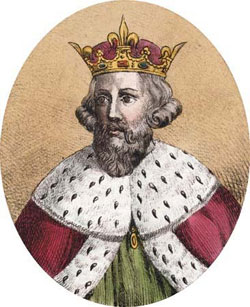
Feastday: July 8
Birth: 827
Death: 901
Benedictine abbot also called Grimwald, invited to England by King Alfred in 885. Grimbald arrived in England and declined the see of Canterbury, preferring to remain a monk. He became the abbot of New Minster Abbey at Winchester appointed by King Edward the Elder. Grimbald is credited with restoring learning to England.
Wednesday of the Fourteenth week in Ordinary Time
Book of Genesis 41:55 When the whole land of Egypt started feeling the famine, the people cried to Pharaoh for food, and Pharaoh said to all the Egyptians, “Go to Yosef, and do what he tells you to do.” 56 The famine was over all the earth, but then Yosef opened all the storehouses and sold food to the Egyptians, since the famine was severe in the land of Egypt. 57 Moreover all countries came to Egypt to Yosef to buy grain, because the famine was severe throughout the earth.
42:5 The sons of Isra’el came to buy along with the others that came, since the famine extended to the land of Kena‘an. 6 Yosef was governor over the land; it was he who sold to all the people of the land. Now when Yosef’s brothers came and prostrated themselves before him on the ground, 7 Yosef saw his brothers and recognized them; but he acted toward them as if he were a stranger and spoke harshly with them. He asked them, “Where are you from?” They answered, “From the land of Kena‘an to buy food.”
17 Then he put all of them together in prison for three days.
18 On the third day, Yosef said to them, “Do what I say, and stay alive, for I fear God. (v) 19 If you are upright men, let one of your brothers remain incarcerated in the prison you’re being kept in, while you go and carry grain back to relieve the famine in your homes. 20 But bring your youngest brother to me. In this way your statements will be verified, and you won’t die.”
So they did it. 21 They said to each other, “We are in fact guilty concerning our brother. He was in distress and pleaded with us; we saw it and wouldn’t listen. That’s why this distress has come upon us now.” 22 Re’uven answered them, “Didn’t I tell you, ‘Don’t wrong the boy’? But you wouldn’t hear of it. Now comes the reckoning for his blood!” 23 They had no idea that Yosef understood them, since an interpreter was translating for them. 24 Yosef turned away from them and wept; then he returned and spoke to them. He took Shim‘on from among them and put him in prison before their eyes.
Psalm 33:2 Give thanks to Adonai with the lyre,
sing praises to him with a ten-stringed harp.
3 Sing to him a new song,
make music at your best among shouts of joy.
10 Adonai brings to nothing the plans of nations,
he foils the plans of the peoples.
11 But the counsel of Adonai stands forever,
his heart’s plans are for all generations.
18 But Adonai’s eyes watch over those who fear him,
over those who wait for his grace
19 to rescue them from death
and keep them alive in famine.
The Holy Gospel of Yeshua the MessiahAccording ot Saint Matthew 10:1 Yeshua called his twelve talmidim and gave them authority to drive out unclean spirits and to heal every kind of disease and weakness. 2 These are the names of the twelve emissaries:
First, Shim‘on, called Kefa, and Andrew his brother,
Ya‘akov Ben-Zavdai and Yochanan his brother,
3 Philip and Bar-Talmai,
T’oma and Mattityahu the tax-collector,
Ya‘akov Bar-Halfai and Taddai,
4 Shim‘on the Zealot, and Y’hudah from K’riot, who betrayed him.
5 These twelve Yeshua sent out with the following instructions: “Don’t go into the territory of the Goyim, and don’t enter any town in Shomron, 6 but go rather to the lost sheep of the house of Isra’el. 7 As you go, proclaim, ‘The Kingdom of Heaven is near,’
Wednesday of the Fourteenth week in Ordinary Time
Commentary of the day:
Book of Genesis 41:55 When the whole land of Egypt started feeling the famine, the people cried to Pharaoh for food, and Pharaoh said to all the Egyptians, “Go to Yosef, and do what he tells you to do.” 56 The famine was over all the earth, but then Yosef opened all the storehouses and sold food to the Egyptians, since the famine was severe in the land of Egypt. 57 Moreover all countries came to Egypt to Yosef to buy grain, because the famine was severe throughout the earth.
42:5 The sons of Isra’el came to buy along with the others that came, since the famine extended to the land of Kena‘an. 6 Yosef was governor over the land; it was he who sold to all the people of the land. Now when Yosef’s brothers came and prostrated themselves before him on the ground, 7 Yosef saw his brothers and recognized them; but he acted toward them as if he were a stranger and spoke harshly with them. He asked them, “Where are you from?” They answered, “From the land of Kena‘an to buy food.”
17 Then he put all of them together in prison for three days.
18 On the third day, Yosef said to them, “Do what I say, and stay alive, for I fear God. (v) 19 If you are upright men, let one of your brothers remain incarcerated in the prison you’re being kept in, while you go and carry grain back to relieve the famine in your homes. 20 But bring your youngest brother to me. In this way your statements will be verified, and you won’t die.”
So they did it. 21 They said to each other, “We are in fact guilty concerning our brother. He was in distress and pleaded with us; we saw it and wouldn’t listen. That’s why this distress has come upon us now.” 22 Re’uven answered them, “Didn’t I tell you, ‘Don’t wrong the boy’? But you wouldn’t hear of it. Now comes the reckoning for his blood!” 23 They had no idea that Yosef understood them, since an interpreter was translating for them. 24 Yosef turned away from them and wept; then he returned and spoke to them. He took Shim‘on from among them and put him in prison before their eyes.
Psalm 33:2 Give thanks to Adonai with the lyre,
sing praises to him with a ten-stringed harp.
3 Sing to him a new song,
make music at your best among shouts of joy.
10 Adonai brings to nothing the plans of nations,
he foils the plans of the peoples.
11 But the counsel of Adonai stands forever,
his heart’s plans are for all generations.
18 But Adonai’s eyes watch over those who fear him,
over those who wait for his grace
19 to rescue them from death
and keep them alive in famine.
The Holy Gospel of Yeshua the MessiahAccording ot Saint Matthew 10:1 Yeshua called his twelve talmidim and gave them authority to drive out unclean spirits and to heal every kind of disease and weakness. 2 These are the names of the twelve emissaries:
First, Shim‘on, called Kefa, and Andrew his brother,
Ya‘akov Ben-Zavdai and Yochanan his brother,
3 Philip and Bar-Talmai,
T’oma and Mattityahu the tax-collector,
Ya‘akov Bar-Halfai and Taddai,
4 Shim‘on the Zealot, and Y’hudah from K’riot, who betrayed him.
5 These twelve Yeshua sent out with the following instructions: “Don’t go into the territory of the Goyim, and don’t enter any town in Shomron, 6 but go rather to the lost sheep of the house of Isra’el. 7 As you go, proclaim, ‘The Kingdom of Heaven is near,’
Wednesday of the Fourteenth week in Ordinary Time
Commentary of the day:
Saint Justin (c.100-160), philosopher, martyr
First Apology, 39-42
"As you go, make this proclamation: 'The kingdom of heaven is at hand"
When the Spirit of prophecy speaks as predicting things that in the future, he speaks in this way: "Out of Zion shall go forth the law, and the word of the Lord from Jerusalem. And he shall judge among the nations, and shall rebuke many people; and they shall beat their swords into ploughshares, and their spears into pruning-hooks: nation shall not lift up sword against nation, neither shall they learn war any more" (Is 2,3-4).
And that it did happen in this way, we can convince you. For from Jerusalem there went out into the world twelve men who were illiterate, of no ability in speaking: but by the power of God they proclaimed to every race that they had been sent by Christ to teach to all the word of God; and we, who formerly used to murder one another not only refrain now from making war upon our enemies, but also, that we may not lie nor deceive our examiners, willingly die confessing Christ…
And hear how it was foretold concerning those who published hisdoctrine and proclaimed his appearance. It was David, the prophet and king, who spoke thus by the Spirit of prophecy: "Day unto day utters speech, and night unto night shows knowledge. There is no speech nor language where their voice is not heard. Their voice has gone out into all the earth, and their words to the ends of the world.” (Ps 18[19],2)… And again, in another prophecy, the Spirit of prophecy, through the same David spoke as follows: "Sing to the Lord, all the earth, and day by day declare his salvation." … “Let them rejoice among the nations. The Lord has reigned from the tree” (Ps 95 LXX)…
David spoke the above prophecy fifteen hundred years before Christ became a man and wascrucified ; and no one either before him or after was crucified for the salvation of the nations. To the contrary, our Jesus Christ , being crucified and dead, rose again and ascended to heaven where he reigned; and this good news, broadcast among all nations by the apostles, is the joy of all those who expect the immortality he promised.
And that it did happen in this way, we can convince you. For from Jerusalem there went out into the world twelve men who were illiterate, of no ability in speaking: but by the power of God they proclaimed to every race that they had been sent by Christ to teach to all the word of God; and we, who formerly used to murder one another not only refrain now from making war upon our enemies, but also, that we may not lie nor deceive our examiners, willingly die confessing Christ…
And hear how it was foretold concerning those who published his
David spoke the above prophecy fifteen hundred years before Christ became a man and was
____________________________

No comments:
Post a Comment