
"Lord, to whom shall we go? You have the words of eternal life."[John 6:68]
Tuesday of the Fourteenth week in Ordinary Time
Saints of the day:
SAINT PANTÆNUS
Father of the Church
(+c. 216)
Father of the Church
(+c. 216)
This learned father and apostolic man flourished in the second century. He was by birth a Sicilian, by profession a Stoic philosopher. His esteem for virtue led him into an acquaintance with the Christians, and being charmed with the innocence and sanctity of their conversation, he opened his eyes to the truth. He studied the Holy Scriptures under the disciples of the apostles, and his thirst after sacred learning brought him to Alexandria, in Egypt, where the disciples of St. Mark had instituted a school of the Christian doctrine.
Pantænus sought not to display his talents in that great mart of literature and commerce; but this great progress in sacred learning was after some time discovered, and he was drawn out of that obscurity in which his humility sought to bury itself. Being placed at the head of the Christian school some time before the year 179, by his learning and excellent manner of teaching he raised its reputation above all the schools of the philosophers, and the lessons which he read, and which were gathered from the flowers of the prophets and apostles, conveyed light and knowledge into the minds of all his hearers.
The Indians who traded at Alexandria entreated him to pay their country a visit, whereupon he forsook his school and went to preach the Gospel to the Eastern nations. St. Pantænus found some seeds of the faith already sown in the Indies, and a book of the Gospel of St. Matthew in Hebrew, which St. Bartholomew had carried thither. He brought it back with him to Alexandria, whither he returned after he had zealously employed some years in instructing the Indians in the faith.
St. Pantænus continued to teach in private till about the year 216, when he closed a noble and excellent life by a happy death.
Lives of the Saints, by Alban Butler, Benziger Bros. ed. [1894]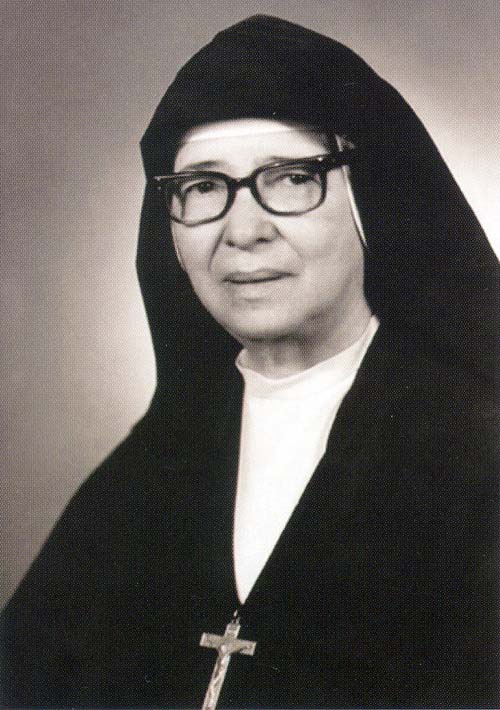
BLESSED MARÍA ROMERO MENESES
Salesian Sister
(1902-1977)
Salesian Sister
(1902-1977)
Blessed María Romero Meneses, Salesian Sister, Social Apostle of Costa Rica, born in Granada, Nicaragua, on 13th of January 1902, died on July 7th, 1977 at Leòn, Nicaragua. Her body rests in the Salesian chapel at San José, Costa Rica. In Costa Rica María was a social apostle though a multiplicity of initiatives designed for the needs of the poor, starting with teaching catechism and vocational skills and finishing with a medical centre, a school for teaching the social doctrine of the Church and seven villages for poor families.
She was one of eight children of an upper class family of Nicaragua. She was beautifully educated by her aunts and her parents. Since she had artistic talent, her parents had María trained in drawing and painting as well as in piano and violin by outstanding teachers. She was also enrolled in the Salesian Sisters' school. In 1914 when she was 12, she underwent a year of sickness whose miraculous cure led to her total confidence in Our Lady, Help of Christians and to the vision of her Salesian vocation.
María came down with a serious form of rheumatic fever that paralyzed her for six months, a real source of trial and suffering because it made her miss a year at her beloved school. However, during this trial, María already showed a mature faith, character and will. She called her sufferings "gifts of God". Even when a doctor informed her that her heart had been seriously damaged, she did not complain, but put her confidence for a complete recovery in Our Lady, Help of Christians.
To a school friend who visited her, she said after receiving heavenly guidance, "I know that the Blessed Virgin will cure me". A few days later, María returned to school in good health; no one could believe she had ever been so sick.
On December 8th, 1915 María joined the Marian Association "Daughters of Mary" offering herself with great confidence to the Mother of God. Her Salesian spiritual director Don Emilio Bottari helped her discern her vocation and her mystical experiences. In 1920, at age of 18, María joined the Daughters of Mary, Help of Christians. Her spiritual director Fr Emilio Bottari gave her a prophetic recommendation: "Even though difficult moments will come and you will feel torn to pieces , be faithful and strong in your vocation". For María, these words sustained her for the rest of her religious life.
On January 6th, 1929 in Nicaragua, María made her final profession. Her interior life unfolded as each day she strived to live joyful union with God as his instrument, after the example of Don Bosco as is apparent from her spiritual writings.
In 1931 she was sent to San José, Costa Rica, which became her second country. In 1933 she was teaching music, drawing, and typing to the rich girls in the school, while beginning in the barrios with catechetics and practical trades. In 1934 Sr María began to win over the young girls who were her students in the school (misioneritas) to join her in the work of evangelizing, catechizing and advancing materially the oppressed, isolated and abused. She found the shape of her life's work: bringing about the revolution of charity by inspiring the have's to help the have-not's. In 1945 she began to set up recreational centres; in 1953 centres for the distribution of food. In 1961 she opened a casita as a school for poor girls. In 1966 a clinic where God's Providence helped her with the volunteer services of fine doctors and donations of needed medicines. Soon she started to plan a village so poor families could have decent homes. On a piece of land outside the city, María began to build homes. In 1973, the first seven homes were built in the Centro San José. Then a farm and a market along with school space for religious formation, catechesis and job training.
There was also a church dedicated to Our Lady, Help of Christians. María always joined love and devotion to the Eucharist and Mary with her social apostolate. María was very "limited" in terms of available funding; but, with total confidence, she always left everything in the hands of Our Lady since it was God's work. In her old age, she retired from full time teaching but never from catechesis of young and old. On July 7th, 1977, in Leon, Nicaragua in the Salesian house where she had been sent for a good rest, María died of a fatal heart attack at 75 years old. Her mortal remains were sent back to San José Costa Rica, to be buried in the Salesian Chapel.
She was beatified by John Paul II on April 14th, 2002. - Copyright © Libreria Editrice Vaticana
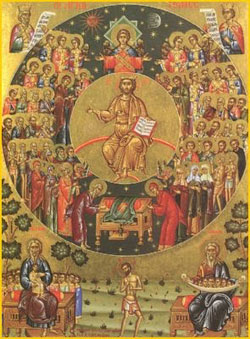
Bl. Ralph Milner & Roger Dickenson
Feastday: July 7
Death: 1591
English martyr. He was born at Stocksteads, Hampshire, and was a convert. He was arrested the day he received his first Communion. A husbands man by trade, Ralph was allowed a leave from prison and aided priests and Catholics. He was executed at Winchester on July by being hanged, drawn, and quartered for giving assistance to Blessed Roger Dickenson. He was beatified in 1929.
Book of Genesis 32:23 (22) He got up that night, took his two wives, his two slave-girls, and his eleven children, and forded the Yabok. 24 (23) He took them and sent them across the stream, then sent his possessions across; 25 (24) and Ya‘akov was left alone. Then some man wrestled with him until daybreak. 26 (25) When he saw that he did not defeat Ya‘akov, he struck Ya‘akov’s hip socket, so that his hip was dislocated while wrestling with him. 27 (26) The man said, “Let me go, because it’s daybreak.” But Ya‘akov replied, “I won’t let you go unless you bless me.” 28 (27) The man asked, “What is your name?” and he answered, “Ya‘akov.” 29 (28) Then the man said, “From now on, you will no longer be called Ya‘akov, but Isra’el; because you have shown your strength to both God and men and have prevailed.” 30 (29) Ya‘akov asked him, “Please tell me your name.” But he answered, “Why are you asking about my name?” and blessed him there.
(iii) 31 (30) Ya‘akov called the place P’ni-El [face of God], “Because I have seen God face to face, yet my life is spared.” 32 (31) As the sun rose upon him he went on past P’ni-El, limping at the hip. 33 (32) This is why, to this day, the people of Isra’el do not eat the thigh muscle that passes along the hip socket — because the man struck Ya‘akov’s hip at its socket.
Psalm 17:(0) A prayer of David:
(1) Hear a just cause, Adonai, heed my cry;
listen to my prayer from honest lips.
2 Let my vindication come from you,
let your eyes see what is right.
3 You probed my heart,
you visited me at night,
and you assayed me without finding evil thoughts
that should not pass my lips.
6 Now I call on you, God, for you will answer me.
Turn your ear to me, hear my words.
7 Show how wonderful is your grace,
savior of those who seek at your right hand
refuge from their foes.
8 Protect me like the pupil of your eye,
hide me in the shadow of your wings
15 But my prayer, in righteousness, is to see your face;
on waking, may I be satisfied with a vision of you.
The Holy gospel of Yeshua the Messiah According to Saint Matthew 9:32 As they were going, a man controlled by a demon and unable to speak was brought to Yeshua. 33 After the demon was expelled the man who had been mute spoke, and the crowds were amazed. “Nothing like this has ever been seen in Isra’el,” they said. 34 But the P’rushim said, “It is through the ruler of the demons that he expels demons.”
35 Yeshua went about all the towns and villages, teaching in their synagogues, proclaiming the Good News of the Kingdom, and healing every kind of disease and weakness. 36 When he saw the crowds, he had compassion on them because they were harried and helpless, like sheep without a shepherd. 37 Then he said to his talmidim, “The harvest is rich, but the workers are few. 38 Pray that the Lord of the harvest will send out workers to gather in his harvest.”
Tuesday of the Fourteenth week in Ordinary Time
Commentary of the day:
Saint Vincent de Paul (1581-1660), priest, founder of religious communities
Spiritual talks given to the Missionary Brothers
The Church is like a great harvest in need of laborers - but laborers who work! Nothing is more in keeping with the Gospel than to draw light and strength for one's soul in prayer, reading and solitude on the one hand, but then to go and distribute this spiritual nourishment to other people. This is to do what our Lord did and, after him, his apostles; it is to unite Martha's task with that of Mary; it is to imitate the dove who digests half the food she has taken and then places the rest with her beak into that of her little ones to feed them. This is what we ought to do, too; this is how we ought to show God by our works how much we love him. Our whole task consists in passing over into act.
____________________________

No comments:
Post a Comment